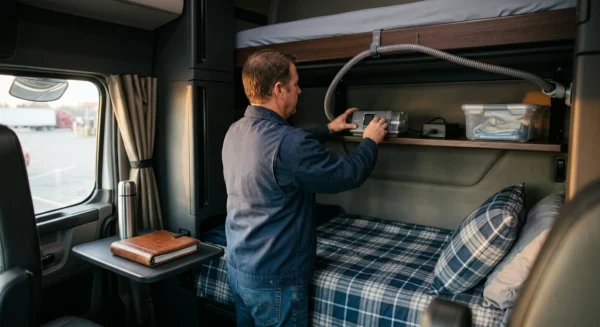
Truck driver sleep apnea is manageable, but you must treat it every time you sleep. That includes sleep at home, in the cab, during naps, and during split sleeper-berth periods. If you snore heavily, wake up choking, get morning headaches, or remain tired after enough time in bed, talk with your doctor and medical examiner.
Sleep apnea repeatedly interrupts breathing and prevents deep, steady rest. You may spend eight hours in the bunk and still feel like you slept in a reefer washout bay. Fatigue can slow reactions, weaken judgment, and make lane control harder before you nod off.
Doctors often treat sleep apnea with a CPAP machine, which uses air pressure to keep your airway open. However, the right treatment depends on your diagnosis and medical history. Drivers who control their symptoms may still qualify for medical certification. Work with your doctor and medical examiner to create a plan that fits life inside a cramped, power-hungry truck.
How Truck Driver Sleep Apnea Affects the Workday
Untreated sleep apnea causes more than yawning at fuel islands. It can leave you foggy during pre-trip inspections and slow your response to brake lights. You may also misjudge following distance or overlook a car riding beside the trailer.
The danger often builds quietly. A driver may feel mostly fine until heavy eyelids, wandering thoughts, or lane drift begin. At that point, safe driving may already be difficult.
Common warning signs include loud snoring, pauses in breathing, gasping, dry mouth, and morning headaches. Poor concentration, irritability, restless sleep, and daytime sleepiness may also occur. Some drivers wake often to use the bathroom without knowing that disrupted breathing contributes to the problem.
These symptoms do not confirm sleep apnea, but they justify a medical evaluation. Excess body weight can increase risk, yet thin drivers can also develop the condition. Age, airway anatomy, family history, alcohol, smoking, and certain medical conditions may contribute.
Get Evaluated and Keep Your Medical Examiner Involved
Start with your primary care doctor, a sleep specialist, or a clinician recommended by your medical examiner. The clinician will review your symptoms and sleep history. You may need an overnight sleep-center study or a home sleep test.
Follow every testing instruction carefully. A poor or incomplete recording can delay the diagnosis and force you to repeat the test. Ask the clinic how driving schedules, daytime sleep, or recent shift changes could affect testing.
FMCSA does not set one sleep apnea testing or CPAP compliance rule for every commercial driver. However, federal standards require drivers to remain physically able to operate safely. A certified medical examiner evaluates your condition, symptoms, treatment, and supporting records before making a certification decision.
The examiner may request more evaluation when symptoms remain untreated or records are missing. The examiner may also issue a shorter certification period to monitor treatment. Properly controlled sleep apnea does not automatically disqualify you from commercial driving.
Ask what documentation the examiner wants before your appointment. The list may include a CPAP usage report, treatment summary, or clinician’s note. Carriers may set separate documentation policies, so request their instructions in writing.
Make CPAP Use Work in a Sleeper Cab
A CPAP machine cannot help when it sits at home while you are hauling through Wyoming. Give it a permanent location with adequate airflow. Make sure it cannot fall during hard braking or block an exit.
Secure the machine, hose, cord, and water chamber. Loose equipment can become a projectile or slide toward the pedals. Keep the air intake away from curtains, bedding, smoke, and dusty vents.
Use the power equipment that the CPAP manufacturer approves. Depending on the model, you may need a direct-current adapter or an inverter with the correct capacity and output. Never cut wiring, bypass fuses, or improvise connections to the truck’s electrical system.
Confirm your power plan before accepting a load. Options may include an APU, shore power, a properly installed inverter, or a system designed for hotel loads. Heated tubing and humidifiers can increase power use, so include them when estimating battery demand.
If you slip-seat, ask dispatch what each assigned truck provides. Test the outlet while maintenance staff can still help. Do not wait until bedtime to discover that the outlet turns off with the key.
- Secure the machine: Use a stable surface, adequate ventilation, and a nonslip mat or suitable restraint.
- Protect the hose: Route it away from cabinet edges and other snag points.
- Test the power: Check the outlet, adapter, humidifier, and heated hose before leaving the terminal.
- Monitor battery capacity: Follow the truck and CPAP manufacturers’ instructions for hotel loads.
- Plan for service: Save the equipment provider’s number and identify service locations along your route.
Build a Routine for Irregular Dispatch
Truck schedules rarely match a fixed bedtime. Instead, build your routine around actions you can repeat before every sleep period. Darken the sleeper, reduce unnecessary noise, and keep the bunk comfortably cool.
Prepare navigation, alarms, paperwork, and clothing before lying down. This keeps your brain from sorting freight problems in bed. A short, consistent wind-down period can also make irregular sleep schedules easier to manage.
Use CPAP during every sleep period your clinician recommends, including naps and sleeper-berth periods. A split schedule does not make untreated sleep safe. Use the machine during both parts of a 7/3 or 8/2 split whenever you sleep.
Make sure your logs follow current FMCSA hours-of-service rules. Property-carrying drivers generally face an 11-hour driving limit within a 14-hour window after 10 consecutive hours off duty. They must also take a 30-minute break after eight cumulative hours of driving.
Legal hours do not guarantee alertness.
Confirm current rules with FMCSA, especially when using split sleeper provisions or exceptions. Never continue driving only because your ELD shows available time.
Fix Mask Leaks and Discomfort Early
A mask that leaks, pinches, or whistles can turn treatment into a nightly fight. Mask fit may change with sleeping position, facial hair, worn cushions, strap tension, or weight changes. Pulling every strap tighter often creates pressure points without stopping the leak.
Ask your equipment provider or sleep clinician to check the mask style and size. Options include nasal pillows, nasal masks, and full-face masks. Your breathing habits, prescribed pressure, comfort, and medical needs determine the right choice.
Do not change prescribed pressure settings on your own. If the airflow feels wrong, call the clinician or equipment provider. They can review your treatment data and identify the cause.
Report dry mouth, congestion, skin irritation, or air blowing toward your eyes. Humidifier settings, allergies, mouth breathing, and worn cushions can all cause trouble. Early adjustments can prevent missed treatment.
- Air leaking near the eyes: Reseat the mask while lying in your normal position. Ask the provider to check the cushion and size if leaking continues.
- Dry mouth or nose: Discuss humidification and mask choice with your clinician. More humidity does not always solve the problem.
- Pressure marks: Check cushion placement and strap tension. Report broken skin or continuing pain.
- Water in the hose: Place the machine below head level when practical. Ask about suitable humidity or heated-tube settings.
- Claustrophobia: Practice wearing the mask while awake and safely parked. Increase the time gradually with guidance from your clinician.
Clean and Inspect CPAP Equipment on the Road
Road dust, skin oils, and moisture can shorten equipment life and weaken the mask seal. Follow the manufacturer’s instructions for cleaning the mask, cushion, hose, chamber, and filters. Do not put harsh cleaners, scented oils, or unapproved disinfectants in the equipment.
Store cleaning supplies in a sealed bin. Let washed parts dry fully in a clean area away from diesel fumes, cigarette smoke, and direct heat. Use the water type recommended by the manufacturer.
Carry enough water for the trip, but store it securely. Protect containers from freezing, leaks, and hard stops. Replace any container that becomes dirty or damaged.
Inspect the hose for cracks and the mask for worn seals. Check the power cord for damage and the filter for clogging. Follow the manufacturer’s directions and your provider’s replacement schedule.
Contact the equipment provider if the machine displays an error, smells hot, makes a new noise, or repeatedly shuts down. Stop using damaged electrical components. Do not attempt internal repairs.
Protect Treatment Data and Carry the Right Records
Many CPAP units record usage and treatment information. Some machines send data through a built-in connection. Others use a removable card or require a manual download.
Ask your equipment provider how your machine stores and shares information. Do this before a long run or medical examination. Keep the machine’s date and time correct, especially if you cross time zones often.
Do not erase records, alter data, or swap memory cards carelessly. Missing information can create a paperwork problem even when you used the machine. Store removable cards in a protective case when they are outside the device.
Request reports well before a DOT medical examination or carrier review. This gives you time to correct transmission or card problems. Keep contact information for the sleep clinic and equipment provider in case the examiner needs verification.
If anyone gives you a compliance target, ask for the details in writing. Confirm the reporting period, required documents, and calculation method. Do not rely on yard gossip or another driver’s certification experience.
Know What to Do When the CPAP Machine Fails
A failure at home is inconvenient. A failure with a loaded trailer and limited legal parking can disrupt the entire trip. Troubleshoot only while safely parked and follow the manufacturer’s instructions.
Check the approved power connection, cord seating, outlet, filter, and water chamber installation. Read any displayed error message. Do not open the machine, splice cables, bypass fuses, or change prescribed settings.
Call the equipment provider, sleep clinic, carrier safety department, or medical examiner as appropriate. Record whom you contacted and what that person advised. Save error messages, service notes, and receipts.
If you cannot use prescribed treatment and do not feel adequately rested, do not drive. Find legal parking instead of stopping on a highway shoulder or ramp. Use the shoulder only during an actual emergency.
- Park legally and secure the truck. Never troubleshoot electrical equipment while moving.
- Check external causes. Inspect the approved cord, outlet, adapter, chamber, filter, and visible connections.
- Read the error message. Follow only the manufacturer’s troubleshooting steps.
- Call the equipment provider. Ask whether the machine needs an approved reset, repair, or replacement.
- Notify dispatch. Explain clearly that equipment failure may affect your rest and fitness to drive.
- Document the problem. Keep notes, messages, and receipts for the carrier or medical examiner.
Handle Drowsiness Before It Becomes an Emergency
Heavy eyelids, repeated yawning, wandering thoughts, and missed exits warn that alertness is failing. Lane drift and gaps in your memory of recent miles signal even greater danger. Stop before the situation becomes an emergency.
Cold air, loud music, chewing gum, and open windows do not restore alertness. Caffeine may temporarily change how sleepy you feel, but it does not treat sleep apnea. It also cannot replace adequate sleep.
At the first clear sign that you cannot stay alert, find the nearest safe and legal parking area. Do not gamble on driving another hundred miles. Call dispatch after you park.
FMCSA prohibits commercial drivers from texting or holding a mobile phone while driving. Set navigation, audio, and hands-free calling before you roll. Pull over legally when a task requires more attention.
Contact your sleep clinician and medical examiner if sleepiness continues despite regular treatment. Mask leaks or inadequate therapy may be responsible. Medication effects, another sleep disorder, or a separate medical condition may also cause fatigue.
Support Treatment With Better Road Habits
CPAP cannot correct every cause of fatigue, so protect each sleep opportunity. Avoid heavy meals immediately before bed when practical. Discuss alcohol use with your doctor because it can worsen airway obstruction and sleep quality.
Never combine alcohol with driving. Use caution with sleep aids, cold medicines, and allergy products that may cause next-day drowsiness. A legal over-the-counter medicine can still make commercial driving unsafe.
Review every prescription and nonprescription medicine with your doctor or pharmacist. Make sure they know that you operate a commercial motor vehicle. Do not start, stop, or adjust medication based on another driver’s advice.
Regular movement can support sleep quality and general health. Even a short walk around a safe parking area may help after hours behind the wheel. Follow your doctor’s guidance if pain, heart disease, blood pressure problems, or limited mobility affects exercise.
If weight management forms part of your treatment plan, ask for guidance that works with truck-stop food and irregular shifts. Avoid extreme diets or sudden exercise programs without medical advice. Coordinate major changes with your doctor, especially if you take medicine for blood pressure or blood sugar.
Stay Treated, Stay Honest, and Protect Your CDL
A reliable truck driver sleep apnea routine depends on small actions repeated every day. Use the treatment, clean the equipment, protect the power supply, and save the records. Add these tasks to your pre-trip and shutdown routines.
Tell your doctor and medical examiner about continued sleepiness, equipment failures, or treatment changes. Report mask problems instead of quietly skipping therapy. Never hide symptoms or falsify usage information.
A carrier’s policy does not replace medical advice or the examiner’s decision. The certified medical examiner determines whether you meet federal qualification standards in your situation. Ask questions early and keep the requested records current.
The goal reaches beyond completing annual paperwork. Effective treatment helps you inspect the truck, read traffic, and make sound decisions throughout the shift. It protects your health, your CDL, and everyone sharing the road.